Home ICU vs Hospital ICU in Gurgaon: What Can and Cannot Be Done
Request a Callback
Ghar par ICU kab safe hota hai, aur kab nahi? A calm, honest guide for Gurgaon families deciding between a home ICU and a hospital ICU.
When a doctor says your father or mother may be ready to leave the ICU, relief and fear arrive together. Can machines and nurses at home really replace the hospital? This guide gives a straight answer for Gurugram (Gurgaon) families, including what a home ICU cannot do, which is the part most pages leave out.
Home ICU vs Hospital ICU: The Honest Answer for Gurgaon Families
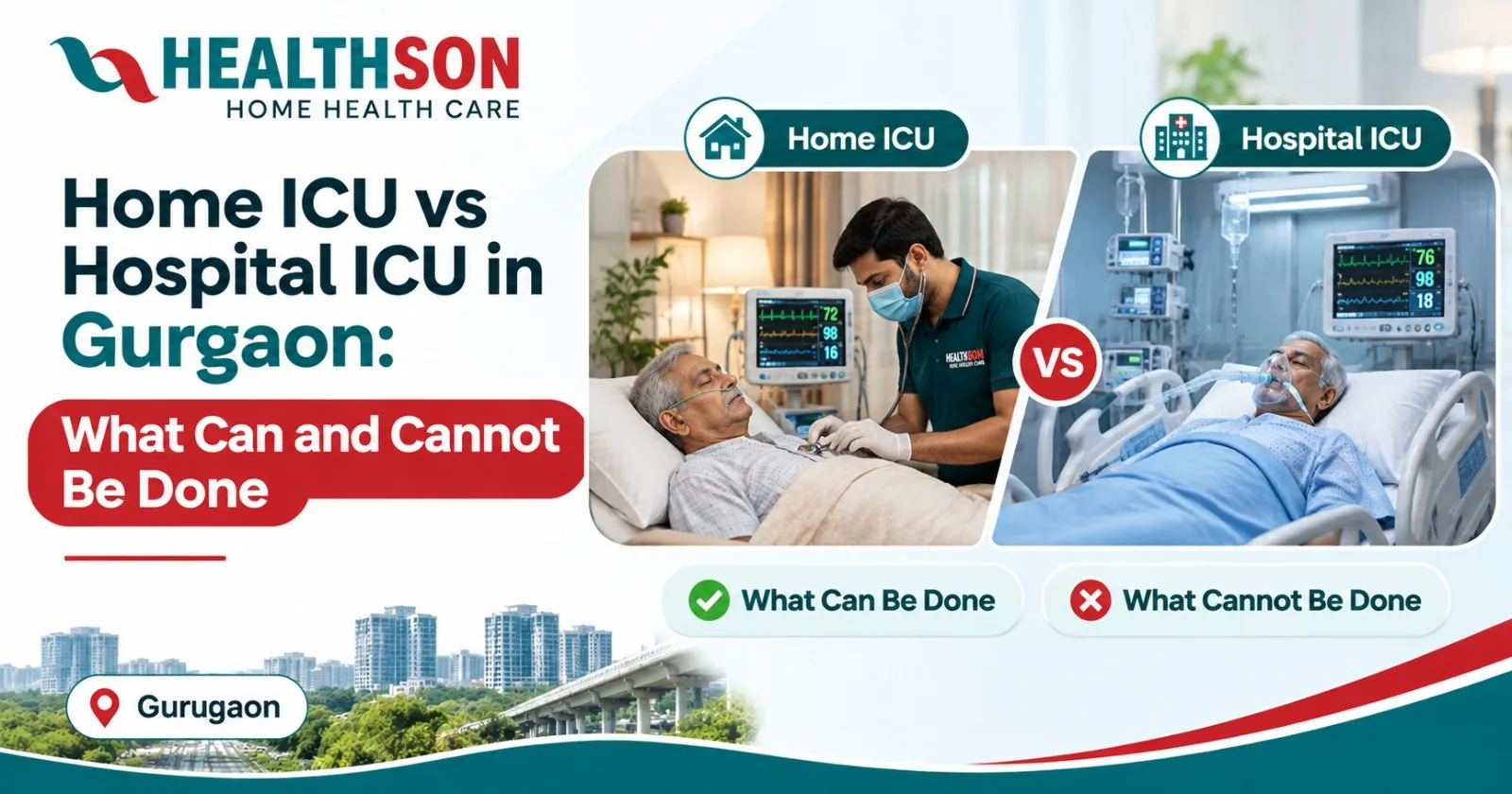
A home ICU is ICU-style care for stable patients, not a copy of a hospital ICU. It works when the patient needs ongoing monitoring and support, and it fails when the patient can suddenly get worse.
A hospital ICU has an intensive-care team on site, laboratories and imaging within minutes, and a team that can respond to a cardiac arrest or start emergency procedures. A home cannot match that. What a home can offer is steady, one-to-one nursing, familiar surroundings and the same kind of monitoring and breathing support, for patients whose condition has already settled.
Published research points the same way. A systematic review of chronically ventilated patients found that non-ICU settings, including home care, can be a comparable alternative to the ICU for stable patients. The key word is stable, and the doctor decides who is stable.
Two honest cautions: Home care does not remove infection risk, because tracheostomy tubes, catheters and ventilator circuits still need strict hygiene. And a home ICU is demanding for the family, who must stay alert, trained and ready to move the patient to hospital.
Side-by-Side Comparison: Home ICU vs Hospital ICU in Gurgaon (Detailed Table)
The table below compares both settings on the points that decide safety and daily life, so you can see where home helps and where only a hospital will do.
| Factor | Home ICU | Hospital ICU |
|---|---|---|
| Best for | Stable patients needing long-term support | Unstable or acutely ill patients |
| Doctor access | Doctor supervision and visits as planned, plus phone escalation | Intensive-care team on site 24 hours |
| Nursing | ICU-trained nurse in 12-hour or 24-hour rotation. Dedicated 1-to-1 care | Nurse often covers more than one patient (1:2 or 1:3 ratio) |
| Emergency response | Nurse acts, doctor is called, ambulance transfer if needed | On-site emergency code blue team and resuscitation gear |
| Tests and imaging | Home sample collections and portable ECG; scans need hospital | Rapid in-house STAT labs, arterial blood gas (ABG), CT/MRI scans |
| Procedures & surgery | Not possible at home | Full operation theatre and procedure suites available |
| Infection exposure | Much lower exposure to multidrug-resistant hospital bugs | Higher exposure to nosocomial hospital pathogens |
| Power and equipment | Dedicated home UPS, inverter and backup oxygen cylinder | Central industrial power grids and on-site biomedical engineers |
| Family and comfort | Family close by 24x7, familiar home room, peaceful sleep | Strict, limited visiting hours; beep alarms, clinical stress |
| Cost structure | Fixed machine rental, nursing shift & consumables; no room rent | Expensive room rent, intensive care bed charges, daily doctor visits |
| Typical duration | Weeks to months of stable chronic or step-down care | Acute, unstable phase until stabilization |
What Can Be Done Safely in a Home ICU Setup? (Conditions & Clinical Care)
A home ICU can safely handle stable, long-term needs such as ventilator or BiPAP support, tracheostomy care, neuro recovery, IV medicines and tube feeding, once a doctor has cleared the patient.
Ventilator or BiPAP support
For medically stable patients. Any change to settings is made strictly under treating doctor guidance.
Tracheostomy care
Regular sterile suctioning, stoma cleaning and inner cannula care by trained ICU nurses.
Stroke & neuro recovery
Continuous vital tracking, Q2H position change to prevent bedsores, and assisted rehabilitation.
IV infusions & antibiotics
Timed administration of prescribed IV medicines via syringe pump or IV drip with cannula care.
Enteral tube feeding
Scheduled Ryle’s tube (NG) or PEG feeding, aspiration checks, and catheter flush maintenance.
Post-surgery recovery
Surgical drain management, sterile surgical dressings, DVT pump prophylaxis, and mobility support.
Home can also suit palliative critical care, where the family and doctor have agreed that comfort and dignity are the primary goal. That conversation belongs with the treating doctor before anything is set up.
What Cannot Be Done at Home (When Hospital ICU Is Mandatory)
Any patient who is unstable, or who may need emergency treatment within minutes, must stay in a hospital ICU.
Septic shock
Needs multiple IV vasopressors to hold blood pressure, rapid dose changes and arterial lines.
Unstable cardiac rhythm
Needs instant cardiac defibrillation, continuous specialist ECG analysis and emergency drugs.
Emergency procedures
Exploratory surgeries, bronchoscopy, endoscopy, and re-intubation require hospital theater teams.
Acute organ failure
Emergency hemodialysis, CRRT, liver failure management, and acute multi-organ decompensation.
Massive internal bleeding
Requires blood bank component transfusions (PRBC, FFP, platelets) and surgical intervention.
Rapidly rising FiO2 need
A patient whose breathing support keeps increasing cannot be stabilized at home.
⚠️ Hospital warning: do not delay transfer
- Sudden breathlessness, falling oxygen level or a blocked tracheostomy that suction does not clear
- Very low blood pressure, a very fast or very slow pulse, or loss of consciousness
- Heavy bleeding, repeated seizures or severe chest pain
- Any monitor alarm or clinical parameter that the doctor’s written escalation plan states needs hospital care
Call 112 or your emergency ambulance, and take the patient to the planned hospital immediately.
Is ICU at Home Safe? 5 Pillars That Decide Patient Safety
Home ICU is safe only when all five pillars are in place: doctor clearance, trained nurses, reliable equipment and power, doctor oversight with a clear escalation plan, and a ready hospital transfer plan.
1. Doctor Clearance & Stability Criteria Before Discharge
A treating intensivist or doctor must certify the patient as stable before shifting, and no one else can make that call for the family.
Stable usually means blood pressure and heart rhythm are steady without IV drugs holding them up, breathing support settings have not been changing, and there is no new acute problem under investigation. The doctor decides what counts as stable for this patient. Ask for the opinion in writing, with the current settings, medicines, tubes and allergies.
2. 24/7 ICU-Trained Nurses (Why Nursing Skill Beats Machines)
Machines raise alarms, but a trained nurse notices the early signs of trouble, so nursing skill matters more than the equipment list.
A nurse sees a change in colour, effort of breathing, secretions or alertness before an alarm sounds, and knows what to do in the first minutes. HealthsonCare states that its home ICU includes ICU-trained nurses 24x7 in 12-hour and 24-hour rotating shifts. Ask which nurses will be assigned, whether they have worked with your patient’s ventilator model, and what backup cover exists if a nurse takes leave.
3. Medical-Grade ICU Equipment & Power Backup in Gurgaon
Equipment must match the doctor’s prescription and must have a backup for the two things that cannot stop: power and oxygen.
| Item | What it does | Listed by HealthsonCare |
|---|---|---|
| ICU-style hospital bed | Motorized positioning, pressure relief, safe nursing access | Yes (3-5 function beds) |
| Multipara monitor | Continuous ECG, SpO2, NIBP, Respiration & Temperature | Yes (5-para monitors) |
| Ventilator or BiPAP | Supports invasive or non-invasive breathing as prescribed | Yes |
| Oxygen concentrator & cylinder | Steady continuous oxygen, with a reserve if power fails | Concentrator + emergency B/D cylinder |
| Suction machine | Clears oral and tracheostomy secretions to avoid choking | Yes (electrical + battery backup) |
| Syringe pump / DVT pump | Micro-dose medication delivery, leg clot prevention | Available on prescription |
Power Backup Rules for Gurgaon Societies
- Verify how long the ventilator's internal battery lasts (usually 4 to 8 hours depending on model).
- Connect all life-support equipment to an uninterrupted online UPS / pure sine-wave inverter.
- Confirm your society's DG generator changeover speed (DG changeover delay must be under 30 seconds).
- Keep a charged emergency backup oxygen cylinder stored upright with an attached regulator key.
- Test the complete electrical changeover before shifting the patient home.
4. Doctor Supervision & Vitals Escalation Protocol
A home ICU needs a named doctor, a visit schedule set by that doctor, and a written list of readings that trigger a call or a hospital transfer.
HealthsonCare lists doctor supervision on call as part of its home ICU. Ask the treating doctor how often the patient should be reviewed, who may change ventilator settings, and what readings of oxygen level, pulse, blood pressure, breathing rate and temperature mean “call me” and which mean “go to hospital”. Keep this plan on paper near the bed.
5. Emergency Backup & Nearest Hospital Transfer Plan
Choose the hospital, the ambulance and the route before the patient comes home, because decisions are poor in the middle of an emergency.
- Pick the hospital where the patient was treated, and a second one that is nearest to your home.
- Save the number of an Advanced Life Support (ALS) ambulance service that can carry ventilator patients, plus 112.
- Check that the lift in your tower fits a stretcher, and that the society security gate has pre-cleared access for emergency vehicles.
- Keep a packed emergency bag with the discharge summary, medication chart, ID, insurance card, and ventilator tube spares by the exit door.
Hospital-to-Home ICU Discharge Checklist for Gurgaon Families (10 Essential Steps)
Tick all ten steps before the patient leaves the hospital. If any step is missing, ask the doctor and the provider to fix it first.
Medical Clearance
Equipment & Power
Room & Caregivers
Emergency Transfer Plan
Planning a hospital-to-home ICU shift?
Share the discharge summary and doctor’s advice. HealthsonCare’s care coordinator will explain the setup for your Gurgaon sector and answer all questions.
Cost Comparison: What Affects Home ICU vs Hospital ICU Costs in Gurgaon?
Home ICU is often cheaper for long stays because there is no room charge, but the total depends on equipment, nurse shifts and your own setup, so always ask for a written quotation.
| Cost driver | Hospital ICU | Home ICU |
|---|---|---|
| Bed or room | High daily charge by ICU room category | No room charge (bed rented monthly) |
| Breathing support | High daily ventilator/BiPAP machine fee | Monthly or weekly equipment rental |
| ICU Nursing | Bundled in hospital ICU package | 12-hour or 24-hour dedicated 1:1 nurse shift |
| Doctor oversight | Multiple consultant visit charges daily | Scheduled home reviews + on-call tele-access |
| Tests & medicines | Hospital pharmacy & in-house lab pricing | Retail/discounted pharmacy & home lab visits |
| Consumables | Billed per item with hospital margin | Suction catheters, gloves & circuits purchased in bulk |
Be careful with big claims: Pages that promise a fixed percentage saving rarely explain what is included. Always compare written itemized quotations line by line, and check with your insurance provider whether home healthcare is covered under your policy.
How HealthsonCare Sets Up and Manages Home ICU Care in Gurugram
HealthsonCare provides home ICU equipment and ICU-trained nurses in Gurugram, and sets up a home ICU only on the treating doctor’s advice.
According to HealthsonCare, its home ICU service includes a hospital bed, monitors and oxygen setup, ventilator and BiPAP support, suction and nebulisation, ICU-trained nurses 24x7, tracheostomy and Ryle’s tube care, and doctor supervision on call. It is meant for stable critical patients who need long-term monitoring outside a hospital.
- 1 Tell the care team Call, WhatsApp or book online and share the discharge summary and the doctor’s advice.
- 2 The coordinator reviews The team confirms the service in your area and explains the equipment plan, staffing options and quotation.
- 3 Nurse and equipment are matched A verified, ICU-certified nurse is assigned to suit the patient, with tested equipment and medical supplies delivered.
- 4 Care begins at home Care is delivered with regular vitals logging, doctor updates, and clinical support from the supervisory team.
Gurugram is large, so confirm timing for your address. Families in Sector 14 and Palam Vihar, the hospital belts around Sectors 38, 44, 45 and 51, Sohna Road, DLF Phases 1 to 5, Sushant Lok, Golf Course Road, Sector 56 and New Gurgaon can all ask the coordinator to confirm availability and arrival time. Societies with gated entry need gate clearance for the nurse and the equipment.
HealthsonCare reports serving more than 3,300 families across Gurugram and Delhi NCR. Read patient stories on the reviews page, meet the team on the about page, or ask a question through the contact page. For less intensive needs, see nursing care at home, medical equipment on rent and our guide to home nursing services in Gurugram.
Talk to a care coordinator about home ICU
Keep the discharge summary handy. We will explain what is possible for your family member and confirm service for your sector.
Frequently Asked Questions
No. A qualified nurse administers injections on the written order of a Registered Medical Practitioner, and most injectable medicines are prescription drugs. Without a valid prescription or discharge summary naming the drug, dose, route and duration, a responsible home-nursing provider will not give the injection. Ghar par injection lagwane se pehle prescription ready rakhiye.
Usually yes, if it comes from a registered doctor and shows the doctor’s name, registration number, date, patient name, drug, dose, route, frequency and duration. A clear photo or PDF is normally enough to book, and the nurse may ask to see the original or the sealed medicine on arrival. Confirm the exact format with the care coordinator when you book.
There is no single national expiry date for an injection course. The course written on the prescription (for example, once daily for five days) is what the nurse follows. If the prescription is several weeks or months old, or the course has finished, ask the treating doctor to confirm that the injection is still needed before booking again.
You still need a doctor’s prescription, because the nurse acts on the doctor’s order and not on the medicine alone. Keep the sealed carton, check the expiry date, and make sure the brand and strength match the prescription. If the medicine needs refrigeration, keep it cold until the nurse arrives.
HealthsonCare says its nurses usually reach most Gurugram locations within 30 to 60 minutes, and its care team is reachable 24x7 by call or WhatsApp. Actual arrival time depends on your sector, the hour and nurse availability, so the coordinator confirms it when you book. Late-night and early-morning visits are subject to availability.
Yes. Daily and multi-day courses are common after surgery or hospital discharge. Share the full prescription so the coordinator can plan the schedule, and tell them if a dose has a fixed time, for example every 12 hours.
Ask for photo ID and the nurse’s qualification (GNM, ANM or B.Sc Nursing), and ask the provider to confirm background verification. You can also ask for the nursing registration number and check it with the Haryana Nurses and Nurse-Midwives Council or the Indian Nursing Council. HealthsonCare states that its nurses are GNM/ANM-qualified and background-verified.
Used needles and syringes are biomedical sharps and should never go loose into household trash. Under the Bio-Medical Waste Management Rules, 2016, sharps belong in a puncture-proof, leak-proof container. Ask your provider in advance who takes the used sharps away, and if you self-inject insulin, keep a rigid sharps container at home.
Contact the doctor who prescribed the injection, or take a consultation with a registered doctor in person or by video, and ask for a clear written order. After a hospital stay, ask the ward for the discharge summary with the medicine list. Do not let anyone inject from memory or from an old strip.
HealthsonCare Clinical Editorial
Reviewed for clinical accuracy and patient safety in accordance with Indian Medical Regulations.